
Nix the Nitrous / Pas de Protoxyde
The Nix the Nitrous / Pas de Protoxyde campaign offers a comprehensive toolkit and supporting resources to help healthcare facilities across Canada phase out centralized nitrous oxide (N₂O) supply systems. The campaign also aims to prevent the inclusion of these systems in new hospital builds, due to their significant environmental, financial, and health impacts.
These materials provide compelling evidence that transitioning from centralized systems to portable, point-of-care E-sized cylinders can virtually eliminate these negative impacts. While we advocate for the complete removal of nitrous oxide in clinical practice—particularly in anesthesia—we recognize that clinical consensus on this varies across the country.
Nitrous oxide (commonly known as laughing gas) is traditionally used in healthcare settings for pediatric perioperative care, labour, and dental procedures. Historically, its role as a carrier gas in anesthesia necessitated centralized bulk storage and distribution systems—installations still found in most Canadian hospitals.
However, advances in anesthetic practices and the development of safer, more effective alternatives have drastically reduced the clinical need for nitrous oxide. Despite this, centralized systems continue to be installed in new healthcare infrastructure.
Pioneering work, led by Alifia Chakera through the Nitrous Oxide Project within the UK NHS and followed up in the US by the Cascadia Nitrous Oxide Collaborative, discovered that even with a significant clinical decline in N2O usage, their hospitals were still purchasing large quantities of nitrous oxide for their centralized N2O supply systems.
They found that regardless of their centralized supply system maintenance frequency, they were still only seeing a delivery efficiency of 1-15%. In other words, 85-99% of their purchased nitrous oxide was lost within the supply system as leakage before being used clinically.
By eliminating nitrous oxide use or switching to portable, point-of-care E-sized cylinders where clinically necessary, these hospitals dramatically reduced waste and risk, while improving sustainability and safety.
The consequences of nitrous oxide leaks are substantial. N₂O is a potent greenhouse gas with a global warming potential 273 times greater than CO₂ and is also an ozone-depleting substance. Its unintentional release contributes meaningfully to climate change and the thinning of the ozone layer. Hospital audits across Canada have shown greenhouse gas emissions from centralized N₂O supply systems in the hundreds and often thousands of tonnes of CO2 equivalent per year.
In addition to its environmental toll, leaked nitrous oxide can accumulate in clinical areas, potentially exposing staff and patients to chronic low-level exposure—a direct occupational health concern.
Decommissioning centralized nitrous oxide supply systems and, where needed, using portable point-of-care cylinders offers a practical, high-impact strategy with clear benefits:
- Environmental Stewardship: Reducing system leaks dramatically cuts hospital greenhouse gas emissions.
- Health and Safety: Eliminates a source of occupational exposure for healthcare staff and patients.
- Cost Efficiency: Hospitals save by reducing gas waste, avoiding leak detection and repair costs, and eliminating the high capital cost of installing centralized systems in new builds.
Our Resources
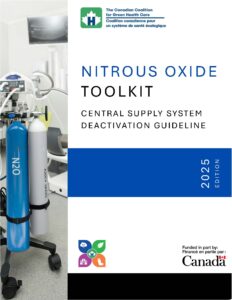

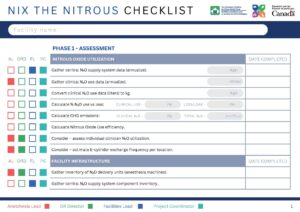
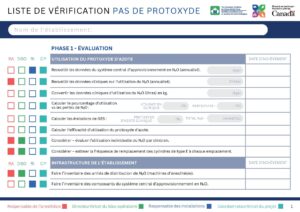

Webinars

Rethinking Nitrous Oxide in Health Care: An Environmental and Economic Initiative
This webinar provides education on the clinical uses for nitrous oxide and highlights the significant economic and environmental benefits to a nitrous oxide mitigation program. Listen as speakers review the steps to decommissioning existing centralized nitrous oxide delivery systems and discusses how to engage stakeholders in new hospital developments to ensure that centralized delivery systems are not part of the infrastructure.
Additional Resources
- Association des Anesthésiologistes du Québec (AAQ)
- “The AAQ supports decommissioning central N2O pipelines in existing hospitals, no longer installing them in new hospitals, and, if necessary, working with N2O cylinders.”
- Canadian Anesthesiologists’ Society (CAS)
- “Eliminate or minimize the use of nitrous oxide to the extent possible given local resources, location and clinical context. If there is no viable alternative and the use of nitrous oxide is still needed in some areas, central nitrous oxide pipelines should be replaced by portable e-sized cylinders”
- Full statement link: https://www.cas.ca/CASAssets/Documents/Advocacy/Envir_PosStatement_Dec2024.pdf
- Association des médecins d’urgence du Québec (AMUQ)
- “Shut down central N2O lines in the ER and do not install them in new ERs.”
- Full statement link: https://amuq.qc.ca/assets/memoires-et-positions/Prise-Position_Usage-rationnel-en-sedation-procedurale-N2O_2024.pdf
- L’Institut national d’excellence en santé et en services sociaux (INESSS)
- “INESSS recommends…the shutdown of centralized nitrous oxide distribution systems (by stopping the supply to these pipelines); and the exclusion of such systems from the construction plans of future hospital infrastructures.”
- Full statement link: https://www.inesss.qc.ca/publications/repertoire-des-publications/publication/diminuer-lempreinte-carbone-des-agents-anesthesiques-inhales-au-bloc-operatoire-lors-dune-anesthesie-generale-strategies-et-enjeux-a-considerer.html
- Ordre des Sages-Femmes du Québec (L’OSFQ)
- “In line with the recommendations from INESSS for hospitals, existing N₂O pipelines should be shut down and should not be installed in new midwifery service facilities.”
- Full statement link: https://www.osfq.org/medias/iw/Pamphlet-Nox-vf-sans-marques.pdf
- American Society of Anesthesiologists (ASA)
- “The environmental impacts of N2O are significant, and the large contribution of central supply system N2O leaks/losses to total health care-generated N2O emissions is wasteful and unwarranted. Furthermore, N2O is no longer used as a primary anesthetic in most operating rooms, decreasing the need for ubiquitous central supply lines. Transitioning to a portable source for N2O delivery will substantially improve supply system efficiency and decrease total health care emissions without eliminating or restricting N2O use in the clinic.”
- Full statement link: https://www.asahq.org/standards-and-practice-parameters/statement-on-deactivating-central-piped-nitrous-oxide-to-mitigate-avoidable-health-care-pollution
- Consensus Statement of all associations in the UK and Republic of Ireland
- Association of Anaesthetists
- “Nitrous oxide should no longer be considered an essential drug in modern anaesthetic practice, and that continuous supply of nitrous oxide to theatre suites via a pipelined supply is no longer essential. We recommend that Trusts and Health Boards decommission their nitrous oxide manifolds as soon as possible, switching to point-of-use cylinders where individual Trusts and Health Boards feel that access to nitrous oxide remains desirable
- Full statement link: https://anaesthetists.org/Portals/0/PDFs/Position%20statements/Consensus%20statement%20on%20removal%20of%20pipeline%20nitrous%20oxide.pdf?ver=2024-07-25-095247-780×tamp=1721897572977
- Centre hospitalier universitaire Staine-Justine, Montreal, Qc
- Centre hospitalier de l’Université de Montréal, Montreal, Qc
- Collingwood General, Collingwood, ON
- London Health Sciences Centre – SurgiCentre, London, ON
- St. Joseph’s Health Care, London, ON
- Sunnybrook Health Sciences Centre, Toronto, ON
- Trillium Health Partners, Mississauga, ON
- 40% of Quebec hospitals have decommissioned!
Has your hospital decommissioned your centralized N2O supply and want to add your name to this list? Please email us at coalition@greenhealthcare.ca!
- HHAngus: Central Piped N2O (Nitrous Oxide) Medical Gas Pipeline Systems (link)
- “Given the opinions from the CAS and AAQ to pivot away from using N2O in favour of other friendlier anesthesia techniques, and coupled with the known leakage concerns from centrally piped N2O pipeline systems, an opportunity exists for HCF’s to reevaluate with their anesthesiology department stakeholders the clinical use of N2O and the delivery method. Reevaluating N2O usage and delivery methods also aligns with Annex P recommendations in CSA Z7396.1 medical gas standard.”
- “Given the opinions from the CAS and AAQ to pivot away from using N2O in favour of other friendlier anesthesia techniques, and coupled with the known leakage concerns from centrally piped N2O pipeline systems, an opportunity exists for HCF’s to reevaluate with their anesthesiology department stakeholders the clinical use of N2O and the delivery method. Reevaluating N2O usage and delivery methods also aligns with Annex P recommendations in CSA Z7396.1 medical gas standard.”
- Stantec – Tariq Amlani, P.Eng, LEED AP, Health Sector Leader (link)
- “Always looking for ways to help our clients reduce operational emissions, when we learned nitrous oxide was seeing decreased use by clinicians, we spoke with several clients about it. By eliminating the need for centralized nitrous oxide systems in the designs of their healthcare facilities, we helped them realize significant emissions reductions. We’re glad to be part of the solution.”
- Eliminate ongoing maintenance costs, inspections, and occupational health and safety concerns
- Guidance for decommissioning under CSA Z7396.1:
- CSA Z7396.1:2022 – Section 11.5.2.9 states that: “When a medical gas system or any part of a system is permanently decommissioned, the affected system or part shall be cut and capped at the point of decommissioning as determined by the health care facility, and all associated shut-off valves, terminal units, indicators, alarms, and unburied pipeline shall be removed, if accessible.”
- In a Canadian decommissioning context, a healthcare facility may leave the accessible pipeline untouched. This approach is considered as temporarily decommissioning and significantly reduces the costs, allowing it to be reenabled at a future date if ever required. Project stakeholders should determine if this is the appropriate approach for your site. This is the most common method of decommissioning existing N2O systems.
- Practice Greenhealth
- Presentation includes Facilities Management perspective
- Collaborating to prevent Nitrous Oxide waste in medical gas systems
- Chief Healthcare Executive
- Why hospitals are looking at anesthesia to curb emissions
- NYC Health & Hospitals
- NYC Health and Hospitals cuts annual anesthesia-related carbon emissions by over 50% through deactivation of central piped nitrous oxide systems
- Kampman JM, Plasmans KYQ, Hermanides J, Hollmann MW, Repping S, Sperna Weiland NH. Influence of nitrous oxide added to general anaesthesia on postoperative mortality and morbidity: a systematic review and meta-analysis. Br J Anaesth. 2024 Dec;133(6):1419-1426. doi: 10.1016/j.bja.2024.02.011. Epub 2024 Mar 11. PMID: 38471989.
- Key finding: N2O did not influence postoperative mortality or most morbidity outcomes, but N2O did increase post-operative atelectasis and nausea and vomiting. Considering the environmental effects of N2O, these findings confirm that current policy recommendations to limit its use do not affect patient safety.